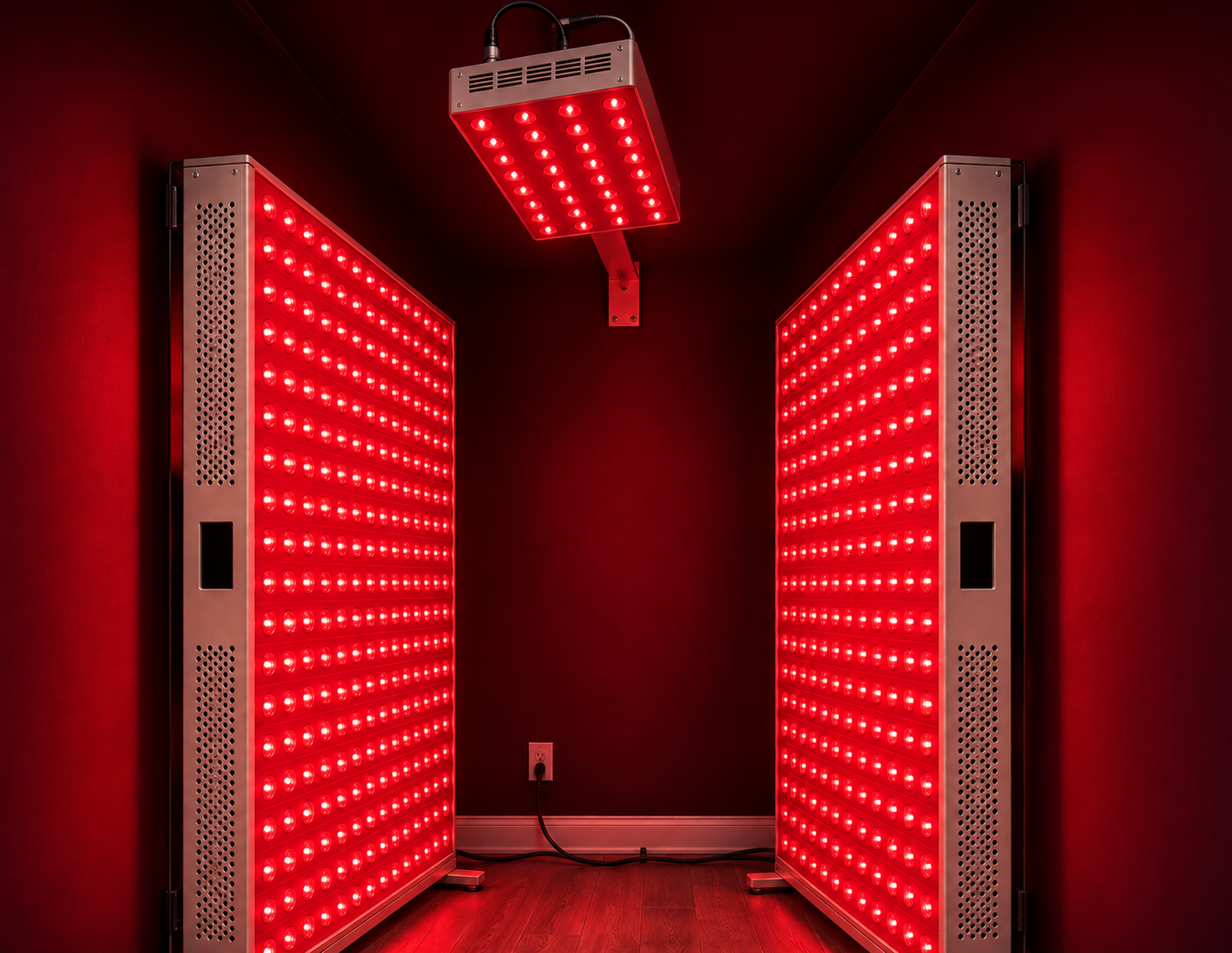
Their individual components have been studied separately.
Research on individual components explains the technologies used in these sessions.
Research on skin appearance and exercise
Red light: research on skin appearance and recovery.
Researchers reported improved skin appearance and collagen density after repeated light treatments. Whole-body exercise studies measured performance, fatigue, and sleep, with different findings for each outcome.
R1 · Wunsch and Matuschka, 2014, Photomedicine and Laser Surgery.
Skin appearance
Researchers reported improvements in skin roughness, appearance, and ultrasound-measured collagen density.
Study context
Skin outcomes were measured after 30 sessions; the comparison group was not randomized.
R2 · Álvarez-Martínez and Borden, 2025, Lasers in Medical Science.
Whole-body exercise performance and recovery
105 physically active participants in total. No benefits were reported for exercise performance or fatigue biomarkers in the included studies. Two studies reported sleep-related improvements.
Study context
The five-study review reported sleep improvements in two studies and no exercise-performance or fatigue-biomarker benefit.
At Hyped, our nine-wavelength setup delivers light from the front, back, and above. Explore the treatment page for our session format.
Vibration: measured improvements in strength and movement.
Reviews report improvements in lower-body strength and physical function in older adults following repeated vibration training programs.
R3 · Tan and colleagues, 2023, Archives of Physical Medicine and Rehabilitation.
Strength and physical performance
Improvements were reported in several strength and physical-performance measures.
Study context
The participants were older adults following repeated training programs.
R4 · de Oliveira and colleagues, 2023, Journal of Clinical Medicine.
A broader look at strength research
Some lower-body strength measures improved compared with control groups. No difference was found between vibration and other forms of exercise. 56% of included studies were rated as having low methodological quality.
Study context
Strength findings varied by outcome; vibration performed comparably to other exercise in this review.
Reviews of targeted PEMF treatment in people with osteoarthritis report improvements in physical function. Pain outcomes differ across reviews and treatment protocols.
R5 · Wu and colleagues, 2018, BMJ Open.
Osteoarthritis review
Reported pain and function improvements for knee and hand osteoarthritis, but not cervical osteoarthritis.
Study context
The review examined targeted osteoarthritis treatments with varied device settings.
R6 · Chen and colleagues, 2019, Journal of Rehabilitation Medicine.
Knee osteoarthritis compared with placebo
Physical-function scores improved. Pain and stiffness did not show a statistically significant advantage over placebo.
Study context
Physical function improved; pain and stiffness were comparable to placebo.
At Hyped, PEMF is a component of selected combined sessions. Our team can explain the mat and session setup.
Hyperbaric oxygen: evidence in medical wound care.
Clinical research has examined hyperbaric oxygen for specific medical conditions. The chronic-wound review below reported increased ulcer healing at six weeks in a pooled analysis of five trials.
Medical research · Chronic wound care
R7 · Cochrane review, 2015.
Chronic wounds
12 randomized trials with 577 participants. Most trials involved diabetic foot ulcers. A pooled analysis of 5 trials involving 205 participants found more healed ulcers at six weeks with HBOT. The benefit was not evident at one year. Major-amputation results were not statistically significant. Trial design and reporting problems reduced confidence.
Study context
These findings concern supervised medical wound care, rather than general wellness sessions.
Hyperbaric equipment requires trained operation, appropriate screening, and adherence to manufacturer instructions. Read FDA safety guidance.
Emsculpt: research on muscle and fat measurements.
Published studies examine muscle and fat measurements following HIFEM body-contouring treatments. Reviews document favorable findings and assess the methods used to measure them.
R8 · Kohan and colleagues, 2024, Aesthetic Plastic Surgery; published online in 2023.
Published body-contouring research
Examined HIFEM treatments, including Emsculpt and Emsculpt NEO. Many studies reported favorable measurements or satisfaction. Two reported marginal or no benefit. Reporting limitations made some results difficult to interpret.
Study context
The review included Emsculpt and Emsculpt NEO, which use different technologies.
R9 · Swanson, 2023, Annals of Plastic Surgery.
Critical review of the same research area
Only one included a sham group. Raised concerns about small measured changes, measurement variability, and manufacturer relationships. Questioned how confidently the published findings establish meaningful benefit.
Study context
This review evaluated study design and measurement quality; it overlaps with the research reviewed in R8.
At Hyped, an applicator uses electromagnetic energy to activate selected muscles during a guided session. Body-contouring measurements and recovery outcomes are different areas of research.
Exercise with oxygen: measured performance during exercise.
A meta-analysis reported improved acute exercise performance while participants breathed oxygen-enriched air. These findings describe performance during the studied exercise tests.
R10 · Mallette, Stewart, and Cheung, 2018, Sports Medicine.
Exercise under oxygen-enriched conditions
Reported improvements in acute exercise performance. Evidence for longer-term training and recovery was limited and variable.
Study context
The measured benefits occurred during oxygen-enriched exercise; lasting training and recovery effects were not established.
BioBlast and Glow Burrito bring several technologies into one guided visit. The studies on this page examine the individual components, rather than these exact combined sessions.
Session
Components described by Hyped
Evidence status
BioBlast
Hyperbaric oxygen, red light, PEMF, and Whole Body Vibration.
The cited studies examine individual components, not this exact combined session.
Glow Burrito
Red light wrap, PEMF, and oxygen-enriched breathing.
The cited studies examine individual components, not this exact combined session.
Exercise with oxygen and resting with oxygen-enriched breathing are distinct setups. Combined sessions require equipment compatibility and an approved operating configuration.
Do not sum study or participant counts across reviews: reviews may include the same underlying trials. These numbers measure different outcomes in different populations and cannot be compared on one scale.
SMD, WMD, and Hedges’ g
Ways to describe a difference between groups. Standardized mean difference (SMD) and Hedges’ g use a standardized scale; weighted mean difference (WMD) uses the measured scale. None is a percentage improvement.
95% confidence interval (CI)
A range showing uncertainty around an estimated result.
Relative risk (RR)
A comparison of how often an outcome occurred in two groups, not how quickly it happened.
Sham treatment
A comparison treatment designed to resemble the real treatment without its active element.
A note on suitability and safety
Choosing a session starts with appropriate screening. Tell our team about relevant health conditions, medications, pregnancy, or implanted devices before your visit. Some services may require medical clearance. Research summaries are educational, not personal medical advice.
Bring your questions.
We’re happy to talk about our equipment and what a session looks like. Please don’t include private medical information in a general inquiry.